“Can I snap it?” My dad heard that from me on a consistent basis when I was growing up.
The rules of the house were very strict, but none so much as the rules of gun-handling. I was taught from the beginning to never consider touching any firearm without express permission and supervision. This was a directive that I understood, took seriously and abided by. My dad knew precisely how to instill the “no-touch rule" and executed it perfectly.
Long before I had the opportunity to shoot a firearm, I was fascinated with my dad’s habit of dry-firing a revolver every night after he’d come home from work. He practiced with two hands, and being an old Bullseye shooter, dry-fired at length with each hand independently. I was perplexed at the fact he would take a pair of leather moccasins, tie their laces together and drape them over the end of a revolver. This added some weight to the gun, therefore building physical strength in the right places.
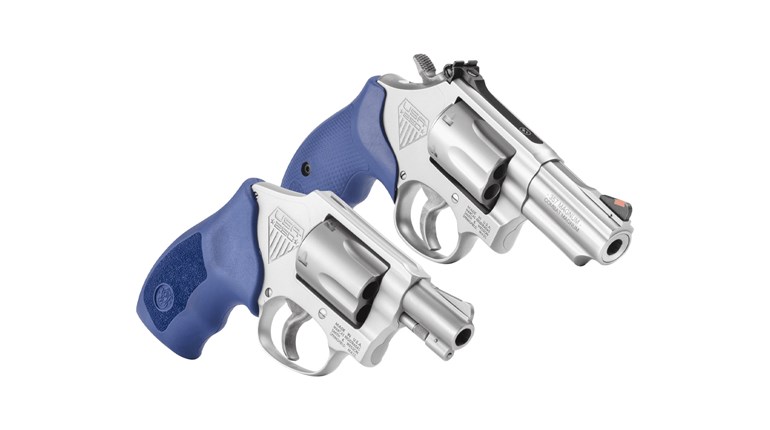
Growing up, I always referred to dry-firing as “snapping” it, a term I rarely use today. When I was old enough, and always with permission, I dry-fired firearms as often as I could. I enjoyed it almost as much as actually firing them. In later years, I prepared myself for the state police academy in New Mexico by firing 100 rounds a day through a Smith & Wesson K-22. If I wasn’t actually shooting the Smith, I was dry-firing it, double-action only. This practice helped me a great deal in firing the NMSP PPC course, which required a number of rounds being fired from the 50-yard line, double-action only.
The most important aspect of dry-firing any firearm is safety. It’s imperative that one makes absolutely certain that the gun is unloaded. Check it repeatedly, especially if you’re dry-firing, put down the firearm for whatever reason, then return to dry-firing. You can never check the chamber of any gun too many times.
It is also very important to aim the firearm in a safe direction while dry-firing it. Indoors, I choose a spot on an outside wall to concentrate on. If the unthinkable happens, i.e., accidentally discharging a live round, an outside wall may prevent the bullet from causing a great deal of damage or injury. A discharge through an indoor wall can allow a bullet to travel through several walls, depending on the caliber.
There are a number of handgun models that I don’t recommend dry-firing. Of course, older handguns such as First Generation Colt Single Action Army revolvers or old model double actions should be pampered. I also don’t care for the ideal of dry-firing a double-action, semi-auto pistol that features a magazine disconnect. This type of pistol requires that the magazine be inserted in order for the trigger to operate. If one insists on dry-firing this type of pistol, it is absolutely imperative that the magazine be checked for live rounds. Inserting a loaded magazine and not chambering a round in order to operate the trigger is not acceptable.
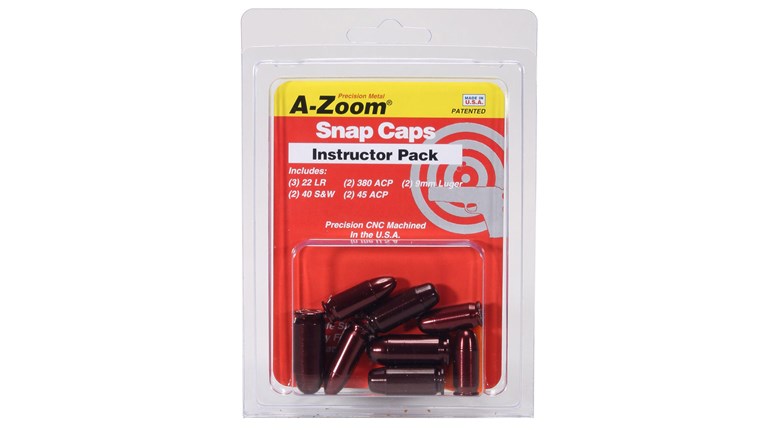
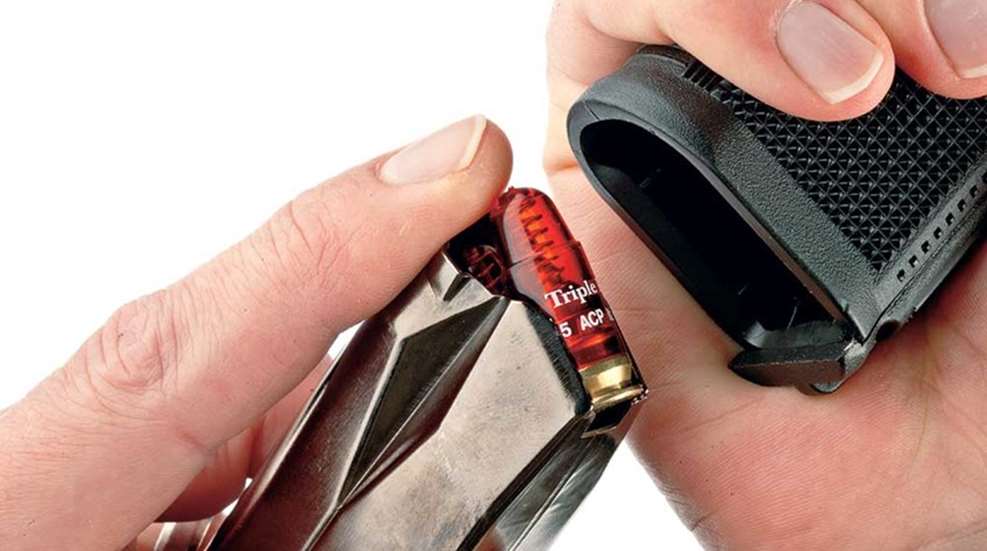
I’m aware that some gun owners are quite sensitive to dry-firing their cherished firearms on the grounds that it might cause damage to the action or firing pin. I certainly agree with this train of thought regarding vintage guns. If you’re concerned about damaging your gun, snap caps or dummy rounds can be used to help guard against damage by cushioning the firing pin. Snap caps are also effective in practicing clearing a failure to feed problem in a semi-auto pistol. This said, I can say that after many years of dry-firing handguns and rifles, I’ve never damaged one as a result of dry-firing.
Dry-firing is a fun and effective technique in shooting practice. I highly recommend it to anyone wishing to inexpensively improve their skills.