** When you buy products through the links on our site, we may earn a commission that supports NRA's mission to protect, preserve and defend the Second Amendment. **
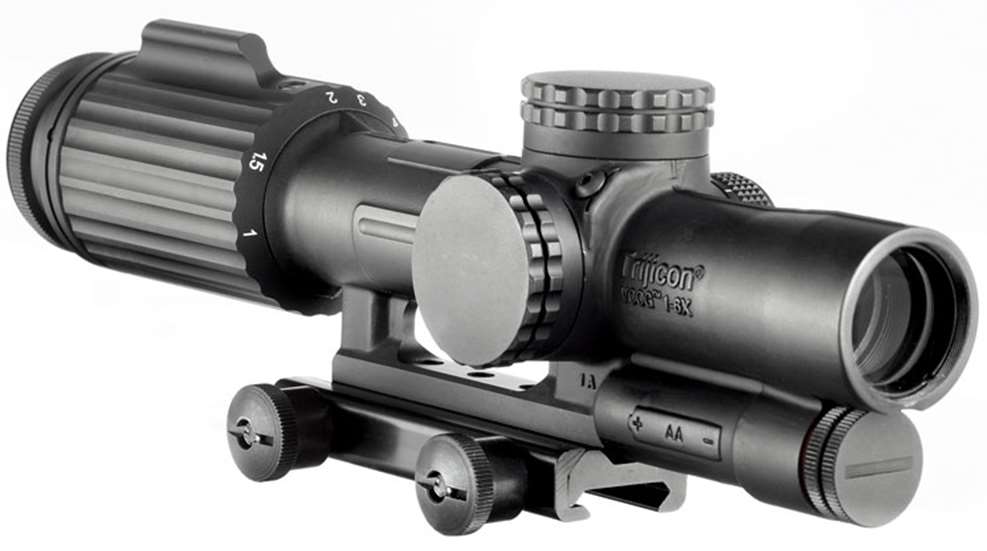
Trijicon became a household (well, in shooting-enthusiast households) name with the Advanced Combat Optical Gunsight, better known as the ACOG. Utilizing a tritium/fiber-optic reticle that automatically adjusts brightness based on ambient lighting, the ACOG is perhaps best known for not needing battery power. This option is quite appealing to folks who fear powered optics will fail at the worst possible time—certainly not an unreasonable fear. In 2013, Trijicon brought the reliability of the ACOG to a variable-power optic, and the Trijicon 1-6x24 mm VCOG was born.
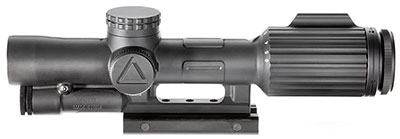
Sporting 1-6X magnification and a host of caliber-specific reticles, the VCOG is precisely matched to a number of varying calibers and bullet weights. Two .223 Rem. options (55- and 77-grain) and one .308 Win. option (175-grain) are available, as is one .300 AAC Blackout option. Reticles come in two flavors: the standard “horseshoe” reticle popularized in the ACOG, and a “segmented circle” reticle with known distances between segments for help in ranging targets. Both reticles contain horizontal stadia for bullet drop at the distance labeled (in 100 meters; i.e. the “4” is the stadia line for a target at 400 meters).
In addition to multiple reticles, the Trijicon 1-6x24 mm VCOG has two different mounting options. A traditional double thumb screw mount is available, as is a quick-release mount with a lever for rapid attachment or detachment. Getting the VCOG on—or off—your chosen rifle or carbine is simple no matter which mount is included, and there’s no need to search for the right rings, or worry about lapping.
Once the VCOG is installed, the fun really begins. Zeroing the rifle was quite simple—at 6X even these old eyes could easily see hits at 50 yards and make adjustments. The first-focal-plane reticle, while taking a little bit of getting used to after dealing mainly with second-focal-plane reticles, ensures the reticle-to-target ratio remains constant. As magnification increases, so does the size of the reticle. If you’re used to the more-common second-focal-plane reticle, it can be unnerving at first; however it’s well-suited for fast-moving applications like 3-gun or predator eradication.
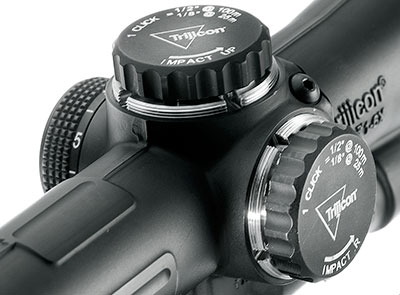
After successful installation on a 16-inch-barreled, AR-15-style carbine, a simple “box drill” confirmed repeatability of adjustments. Three shots on center, then up, right, down, and left brought the final three-round group nearly on top of the original. Adjusting the turrets requires little effort and all clicks are audible as well as tactile—you can feel each half-inch (at 100 meters) change as it is made.
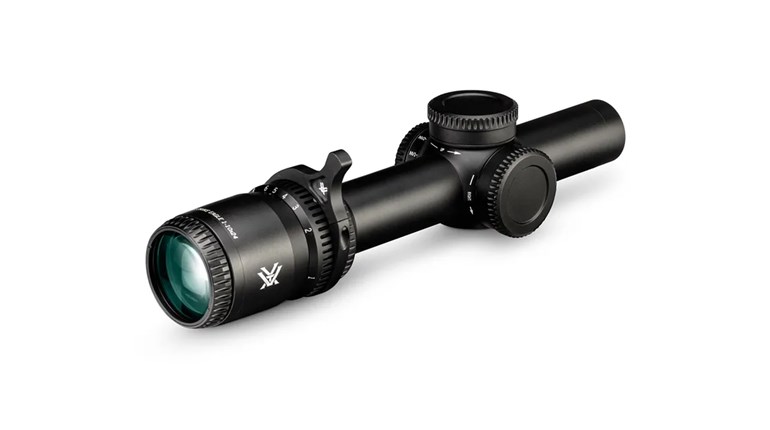
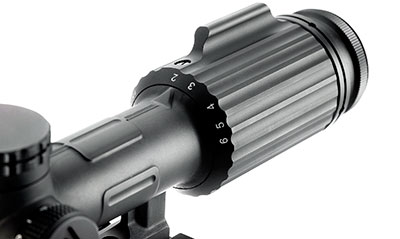
Running a course-of-fire with different distances of engagement made the Trijicon 1-6x24 mm VCOG's biggest strength readily apparent. Changing magnification power is immediate and effortless with the integrated dial fin—rather than utilize a small ring that requires concentration and finger strength to change, the dial fin allows a rolling motion to rapidly increase or decrease magnification. It was quite simple to change from 1X to 2X when moving from 10 to 25 yards, then to 4X at 50 yards, then back to 1.5X at 15 yards.
The segmented circle reticle works very well for targets of moderate size, like a standard Q target or IDPA “A” zone. At the highest setting it’s immediately visible even in direct sunlight (well, sunlight directly overhead; we don’t recommend looking at the sun through any scope). For indoor or lower light levels the mid-ranges work fine for the brightness. Here’s another handy, thoughtful engineering modification the VCOG brings: on the brightness adjustment, there are “off” stops between each level of power—there’s no more running the scope all the way back to “off” from the middle of the dial.
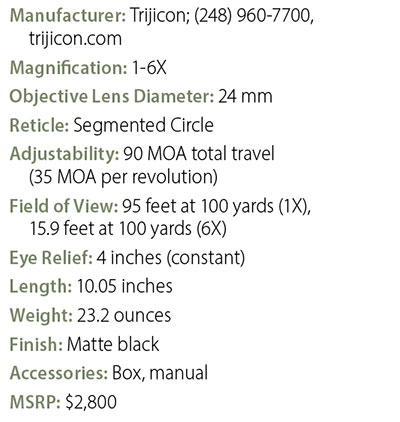 At an MSRP of $2,800, the Trijicon 1-6x24 mm VCOG isn’t exactly budget-friendly. It’s a Trijicon scope, though; a high-end, high-value optic. The VCOG has only been available for a short while, but shares the same ruggedness and heritage as the ACOG. If you’re intending to use your rifle/optic in a variety of endeavors, like 3-gun competition, and want something that can take any punishment you could possibly dream up, the VCOG should prove its worth through years of trouble-free use.
While the VCOG is 10 inches long, the integral mount requires less rail space, leaving room for backup sights.
Sporting 1-6X magnification and a host of caliber-specific reticles, the VCOG is precisely matched to a number of varying calibers and bullet weights. Two .223 Rem. options (55- and 77-grain) and one .308 Win. option (175-grain) are available, as is one .300 AAC Blackout option. Reticles come in two flavors: the standard “horseshoe” reticle popularized in the ACOG, and a “segmented circle” reticle with known distances between segments for help in ranging targets. Both reticles contain horizontal stadia for bullet drop at the distance labeled (in 100 meters; i.e. the “4” is the stadia line for a target at 400 meters).
In addition to multiple reticles, the Trijicon 1-6x24 mm VCOG has two different mounting options. A traditional double thumb screw mount is available, as is a quick-release mount with a lever for rapid attachment or detachment. Getting the VCOG on—or off—your chosen rifle or carbine is simple no matter which mount is included, and there’s no need to search for the right rings, or worry about lapping.
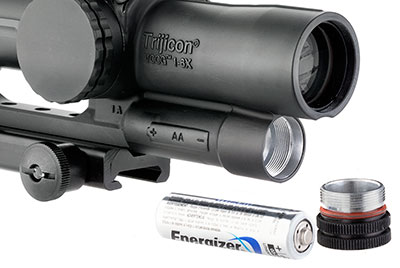
A single AA battery powers the reticle, which is visible even when illumination is turned off.
Once the VCOG is installed, the fun really begins. Zeroing the rifle was quite simple—at 6X even these old eyes could easily see hits at 50 yards and make adjustments. The first-focal-plane reticle, while taking a little bit of getting used to after dealing mainly with second-focal-plane reticles, ensures the reticle-to-target ratio remains constant. As magnification increases, so does the size of the reticle. If you’re used to the more-common second-focal-plane reticle, it can be unnerving at first; however it’s well-suited for fast-moving applications like 3-gun or predator eradication.
Magnification changes are made rapidly and easily using the large dial fin atop the power selector.
After successful installation on a 16-inch-barreled, AR-15-style carbine, a simple “box drill” confirmed repeatability of adjustments. Three shots on center, then up, right, down, and left brought the final three-round group nearly on top of the original. Adjusting the turrets requires little effort and all clicks are audible as well as tactile—you can feel each half-inch (at 100 meters) change as it is made.
Running a course-of-fire with different distances of engagement made the Trijicon 1-6x24 mm VCOG's biggest strength readily apparent. Changing magnification power is immediate and effortless with the integrated dial fin—rather than utilize a small ring that requires concentration and finger strength to change, the dial fin allows a rolling motion to rapidly increase or decrease magnification. It was quite simple to change from 1X to 2X when moving from 10 to 25 yards, then to 4X at 50 yards, then back to 1.5X at 15 yards.
Adjustments to windage and elevation are made in half-inch clicks (for targets at 100 meters) and are both audible and tactile.
The segmented circle reticle works very well for targets of moderate size, like a standard Q target or IDPA “A” zone. At the highest setting it’s immediately visible even in direct sunlight (well, sunlight directly overhead; we don’t recommend looking at the sun through any scope). For indoor or lower light levels the mid-ranges work fine for the brightness. Here’s another handy, thoughtful engineering modification the VCOG brings: on the brightness adjustment, there are “off” stops between each level of power—there’s no more running the scope all the way back to “off” from the middle of the dial.
At an MSRP of $2,800, the Trijicon 1-6x24 mm VCOG isn’t exactly budget-friendly. It’s a Trijicon scope, though; a high-end, high-value optic. The VCOG has only been available for a short while, but shares the same ruggedness and heritage as the ACOG. If you’re intending to use your rifle/optic in a variety of endeavors, like 3-gun competition, and want something that can take any punishment you could possibly dream up, the VCOG should prove its worth through years of trouble-free use.