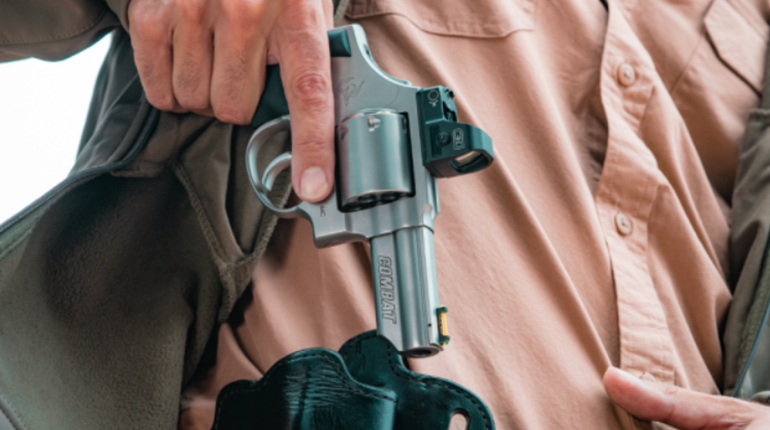
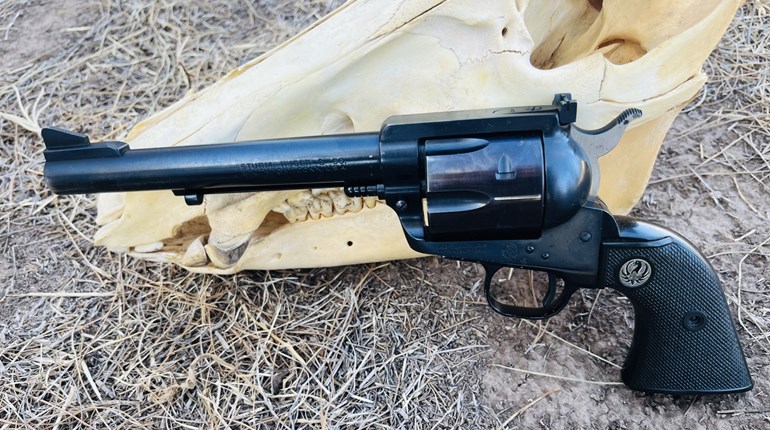
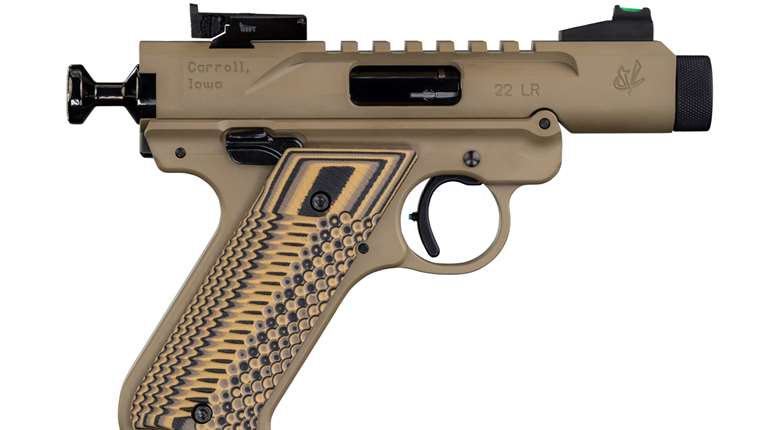
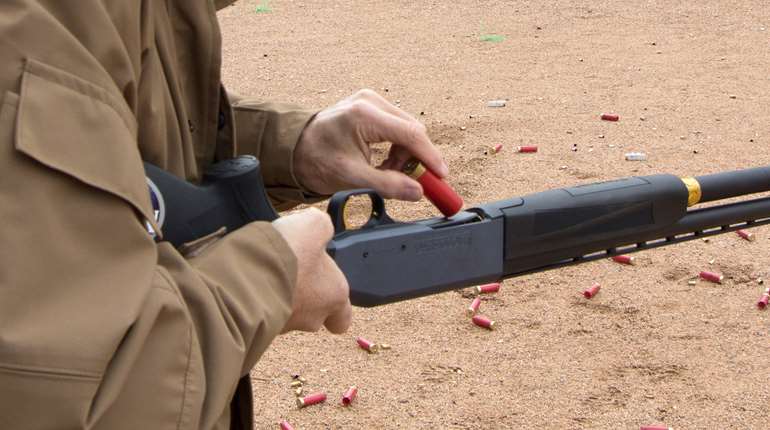
One of my shooting buddies has a daughter who is moving away to attend graduate school, and wanted a home-defense gun. His solution was to gather up a broad selection of handguns, go to the gun range and let her decide. So, the young lady shot several small revolvers and various sizes of semi-automatics, and finally made her selection. Her choice was a 1970s-era Smith & Wesson Model 19 revolver. She liked it because it fit her hand, she shot it well and she understood how it worked. Smart lady.
Selecting a personal-defense gun is a very personal thing, and to begin with, it must fit the shooter’s hand. Proper fit is for the gun to be centered in the web of the hand between the thumb and index finger. In addition, the barrel of the gun should be in a straight line with the wrist and forearm. Depending upon the gun chosen, we might adjust this a little bit by changing to thinner stocks or thicker ones. Positioning the gun in the hand in this manner allows us to exert our strongest grip on the pistol while simultaneously allowing us to have greater control for faster shooting and follow-up shots.
Another factor to consider is the position of the trigger finger. With a single-action pistol, the first pad of our trigger finger should be centered on the trigger. With a double-action trigger the first joint of the trigger finger should be centered on the trigger. These positions give us the best control over the all-important trigger press.
One of the things that causes us problems in selecting that perfect handgun is what I call length-of-pull. That is the distance from the pistol’s backstrap to the center of the trigger. If that distance is too long, then the trigger finger will not be able to address the trigger properly and our marksmanship will suffer.
That is exactly the problem I have when it comes to Smith & Wesson N-frame revolvers. The length-of-pull is just too long for me to grip the gun properly and, at the same time, properly address the trigger. I’ve tried thin stocks, thinner stocks and even grip adapters—all to no avail. It’s not Smith & Wesson’s fault; it is solely my problem due to my average-size hands. I love those big-’ol Smiths; I just don’t shoot them well.
Another important factor in making the selection is how well a person shoots a particular gun. Of course, to make an intelligent decision, the person first needs to know how to shoot. To borrow a cliché, sometimes we just don’t know what we don’t know. This can be fixed fairly quickly by attending any number of shooting schools across the country, not least of which are those sponsored by the NRA. It would even help to attend one of the schools that will rent guns to students. By getting good training, we begin to have a better understanding of our abilities and what our preferences are; in other words, we are now making an intelligent choice.
Confidence in a particular type of defensive handgun also plays an important part in our selection. For several years, as a peace officer, I carried a Colt Government Model chambered in .45 ACP. What endeared this gun to me and what helped me through some serious situations was the fact that it was the same gun I shot on weekends at our local combat matches. I always did quite well in those matches, and that confidence translated into situations that I encountered in my work.
Just like the young lady going to graduate school, it helps to shoot as many different kinds of handguns as possible. Selecting the personal-defense gun is just that—it’s personal—and personal tastes should not be overlooked so long as a person is making the selection from decent-quality guns. Most big cities have gun ranges that will rent guns to customers, and this is an excellent way to get an education at minimal cost. The more guns a person tries out, the more he or she will know about what they like and why they like those qualities.
You might get lucky and find the gun of your dreams in very short order. You might, but I didn’t. I shot lots of guns, traded some and bought others. But, I must tell you it was an enjoyable education, and as a result I now know which semi-autos and which revolvers I can expect to do my best work with.
So, that would be my recipe for selecting the perfect carry gun. Learn to shoot, then make sure the gun fits you and that you shoot it well. Finally, if you find something that fits your needs better, don’t be afraid to trade up. While the whole business of a personal-defense gun is serious business, you will find, along the way, that trips
to the gun range and shooting are enjoyable pastimes. And that’s all good.