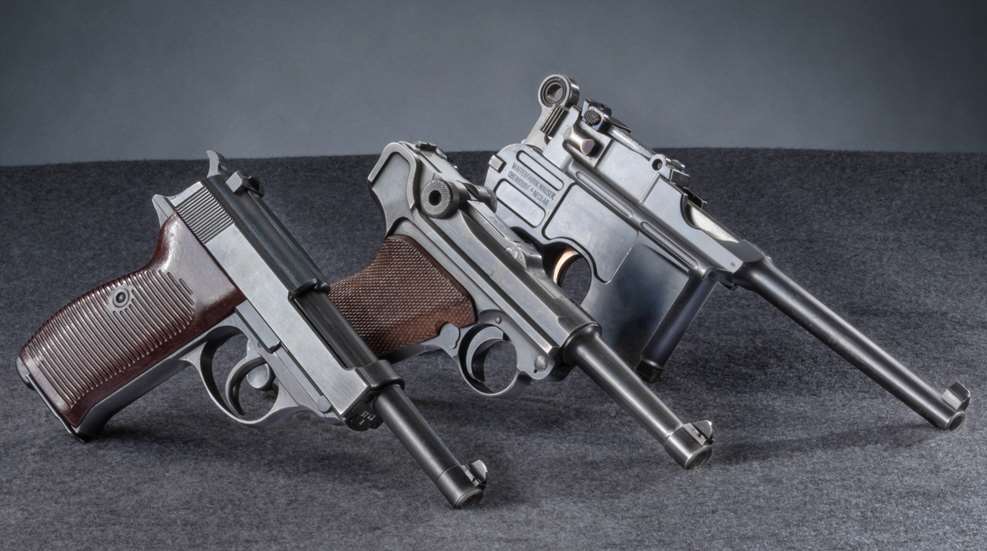
Left to right: Walther P38, Luger P08 and Mauser C96 “Broomhandle” German-designed and made pistols.
For many years, except for American Rifleman there were no real gun-enthusiast magazines. Oh sure, there were several outdoor magazines that reported on hunting and fishing matters. But in the 1950s, the first new gun magazines appeared. One particular subject drew enough reader interest as to warrant a specific editor on the biggest of the new gunzine’s masthead. It chose to identify a “Luger Editor.” This is a reflection of the post-War interest in surplus firearms.
When Germany surrendered, an enormous supply of high-quality small arms was created. Full-automatic arms could not be imported, so the superb German machine guns and submachine guns were ruled out. While the Mauser 98 rifle in any of its many formats was widely used in custom sporting-gun builds, it was another type of firearm that drew the greatest interest. Americans love the handgun, and the German arms industry produced some of the best ever made.
I can recall pictures of heaps of P38s in German warehouses ready for shipment to America in the ’50s. There was never another time when such a wide array of quality pistols was available for such low prices. Those new gun magazines ran ads for Lugers in four grades of condition. For a gun buff, it was a small paradise—a $30 Luger?
Germany fought two major wars in the first half of the 20th century, lost both, but never lacked quality armaments. It had some of the best to be had. For the most part, the domestic makers were Mauser, Luger and Walther. The three 9 mms mentioned here—and the leaders in the import wars of the 1950s—were the Mauser C96, Luger P08 and Walther P38. Let’s look at them in that order.
The Mauser was one of the early (1896) 9 mm semi-automatic pistols. In America, it is almost universally identified as the “broomhandle” Mauser, since the butt section has a definite resemblance to the handle on a whisk broom. Shipped with a wooden combination buttstock and holster, the gun has a definite military character. It has an internal magazine, forward of the trigger guard, with follower and spring in the gun. Loading is via a stripper clip, which is almost as fast as a magazine when using pre-loaded clips. The C96 was originally chambered for the 7.63x25 mm cartridge, a very hot little bottlenecked cartridge that had a strong appeal as a military round. The Broomhandle was made in several models. One of them did have a removable magazine, but it also had a selective-fire trigger system, making it non-importable. C96s always had a reputation for both reliability and accuracy. Shooting the several specimens I have tried did little to counter that notion. They are not the most graceful pistol to behold, but they hit where you point them.
So does the next 9 mm pistol—the immortal Luger. Derived from the toggle-lock system of the earlier Borchardt pistols, the first Lugers were available at the turn of the 20th century. They were used in the Boxer Rebellion through World War II, and I personally recall seeing a Luger in a shoulder rig on a captain in the Army of the Republic of Vietnam. A Luger has an instant appeal by virtue of the pistol’s downright sensuous contours. The appeal grows when you handle the gun and prepare to fire. In a sense, the appeal comes from a prohibitively expensive time involved with the fitting and polishing of the gun. Guns made during World War II, when Germany was getting its back against the wall, were only slightly rougher than the ones made at the turn of the century. The Luger was a fine pistol at its beginning, chambered in .30 Luger, but was better when the manufacturer created the 9 mm for it.
When those importers were offering sleeper Lugers, they were also selling blue-collar Walthers. The gun was the P38. Here, we had a unique breech-locking system as well as a trigger system that was utter practicality. Its breech featured a block that pivoted up and down a few degrees to lock into the inner walls of the slide. The trigger action was DA/SA—a good idea for safe handling of a combat handgun.
Pawn shops of the 1950s were crowded with affordable war-surplus German pistols. I counted 17 Lugers on the top shelf of one case. I tarried for a moment over a Polish Radom, passed on a $45 Luger and purchased a near-new $25 Walther P38. It was a fine time to be a budding student of the fightin’ iron.