Through his binoculars, PFC Ray Register could see four German soldiers setting up a machine gun 350 yards away. Well-concealed at the intersection of two hedgerows deep in the Norman countryside, the Germans were oblivious to the fact that they were being watched. But, PFC Register had been in the Army since before Pearl Harbor, and his senses had been honed by previous combat experience. This is why he was manning an outpost on his company’s defensive line, and why he was equipped with two pieces of specialized equipment to do the job. Having seen all he needed to see, the 22-year-old Alabamian put the binoculars down, shouldered his rifle and opened fire. Four shots rang out in rapid succession and four enemy soldiers fell before Register’s surgical marksmanship.
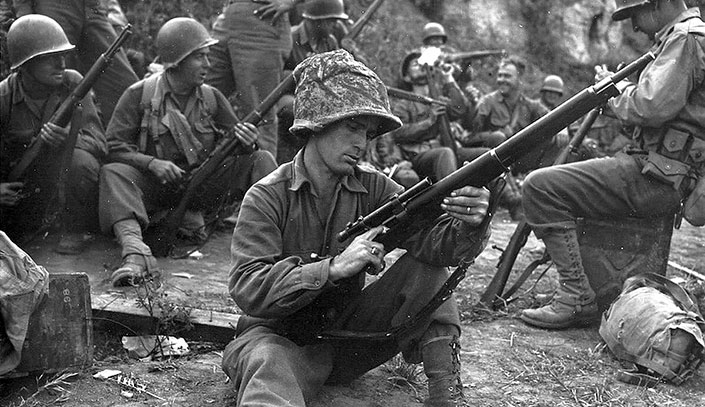
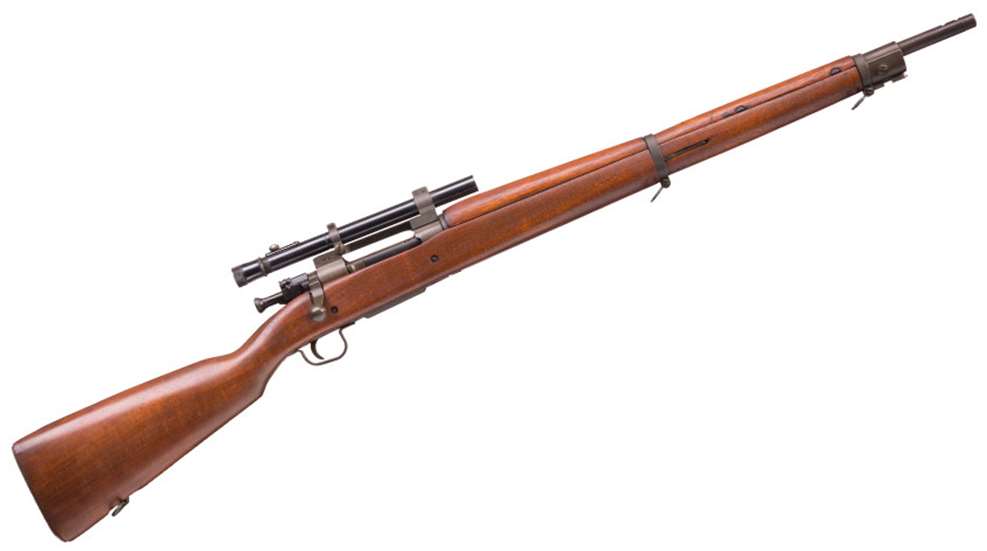
But the gunfire alerted a nearby, previously unseen German observation post, and the rifleman in it began moving around to see where the four shots came from. As he did so, Register noticed rustling branches and shifted his point-of-aim to engage the new target. He squeezed off a shot, a voice cried out and a fifth enemy soldier had fallen in less than a minute. In addition to the binoculars, the firearm was the other piece of specialized equipment that made this impressive feat of arms possible. Register used the five-shot bolt-action rifle that, by the summer of 1944, had been serving the U.S. Army for more than four decades. But, he was not using the standard M1903 that day; he was using the M1903A4 sniper rifle.
Even as the M1 Garand went into production at Springfield Armory in 1937, the old M1903 remained the standard service rifle of the U.S. military. The design had proven itself in combat from the Sulu Archipelago, to Belleau Wood, Vladivostok and Nicaragua, but there was one big problem: there just weren’t enough examples. By late 1939, wars were raging in both Europe and Asia, and the government recognized that hundreds of thousands of rifles would be needed if the U.S. were drawn into either conflict. It was also known that it would take too much time for Springfield Armory to produce the new M1 semi-automatic in sufficient numbers to meet the needs of a full, national mobilization, and the quantity of M1903 rifles on hand was not nearly enough.

In an effort to resolve this shortfall, the U.S. government issued contracts to multiple manufacturers to put the ’03 back into production in Sept. 1941. At first, Remington ’03s generally conformed to the design of the rifles produced by the government armories at Springfield and Rock Island. As Remington continued to turn out guns, though, the design was simplified for mass production over and over again until it was eventually standardized as the M1903A3 on May 21, 1942. During the 21 months that followed, Remington produced 707,629 of them.
Just as deliveries of the new M1903A3 variant began in Dec. 1942, the government ordered a sniper version of the rifle. To meet this specification, Remington mounted a 2.75X Weaver M73B1 telescopic sight on an A3 receiver using a Redfield Junior base and modified the bolt handle to clear the optic’s eyepiece. Since a front sight would be superfluous for the scoped rifle, one was not installed (although the milling cuts for it remained). The factory marked A4 barrels the same way it marked A3 barrels, with a flaming bomb, the initials “RA” as well as the month and year of production. At first, the M1903A4s used a barrel with four-groove rifling, but that was later changed to a two-groove barrel.
Although the government ordered 20,000 M1903A4s in early 1943, it subsequently increased that order to the point that 28,365 rifles had been delivered by the end of production in June 1944. Those rifles fought in the Mediterranean, Northern Europe, the Pacific and the China-Burma-India Theater of Operations. They fought with ground infantry and airborne units alike, and despite the limitations of the Weaver M73B1 scope, in the hands of a skilled marksman the M1903A4 could be an effective piece of battlefield firepower. PFC Register certainly proved that in the hedgerows of Normandy.