It is human nature that when something happens that is totally unexpected (Condition White) people often freeze in place for a moment before jumping into action. While they often cannot articulate this, crooks seem to just naturally understand this phenomenon and use that moment to press their advantage. The proper response is to incorporate movement into your defensive training.
The criminal will often make his attack quickly and from very close range. He uses that moment of indecision on the part of his intended victim to get right in that victim's face. He is quickly in that close area where everyone is a good shot. Movement on your part will not only create distance but it may also throw the crook off of his game just enough for you to overcome his attack.
Depending upon the situation, we may move to either side or on a diagonal. The thing to avoid whenever possible is moving straight back from a threat. A person who tries to quickly move straight back in far more likely to trip on something and end up falling. In addition, and just as importantly, the criminal doesn't have to change his sight picture on his victim.
Of course, the best kind of movement is moving to take advantage of available cover, something that will stop bullets. One of the factors in being aware of what is going on around us is to identify available cover. And if the attacker is armed with a knife or blunt object putting any kind of obstacle between us is advisable and buys time for us to react.
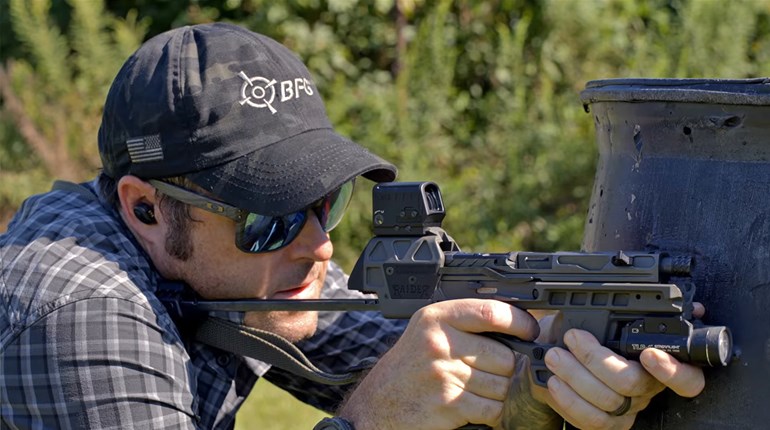
Shooting while moving is not as easy at it may seem at first. It takes a good deal of practice to make solid hits to the vital zone while moving. And one also needs to practice to get his footwork down, making sure that his feet don't get tangled up while quickly trying to react to the threat.
Sadly, many shooting ranges will not allow this sort of practice at their facility. In this case, the defensive shooter is well advised to incorporate movement into his dry practice at home. Moving around in the house is a good way to develop real-world defensive movement techniques. However, don't cheat and clear a space before starting the practice. Learning to move in spite of the kids toys that clutter the floor, footstools, the family pet, and other objects, adds reality to your training.
Incorporating movement into our defensive plan allows us to create distance from the threat, make use of available cover, and generally respond in a manner that might confuse our attacker. But, like most defensive techniques, it has to be thought out and practiced.
So, when faced with a serious threat, don't just stand there. Move!