When most shooters evaluate performance, they focus almost entirely on averages: average hit ratios, average split times, average group size. But, averages only tell part of the story. For defensive gun use (DGU), where every shot may determine survival, consistency is just as important—sometimes more important—than peak performance.
That’s where standard deviation comes into play. While it might sound like a statistic best left to math nerds, it’s actually one of the most useful metrics for defensive shooters. A low standard deviation means your performance doesn’t swing wildly from shot to shot or drill to drill; instead, it stays tightly clustered around your normal baseline. In high-stress encounters, that consistency could be the difference between hitting your target and missing entirely.
Here we’ll explore why standard deviation matters in defensive shooting, how it is applied in testing (using a SIG Sauer P365 XL ported vs. non-ported as an example) and what you can do in training to minimize your own performance variability.
Why Consistency Beats Averages in Defensive Gun Use
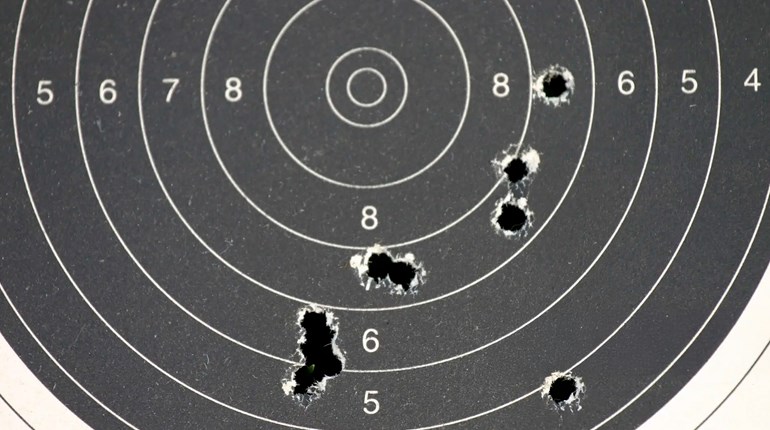
Imagine two shooters with nearly identical average-hit ratios. Shooter A has a hit ratio of 6.3 out of 10 shots, and a standard deviation of .2. Shooter B’s hit ratio is the same 6.3 out of 10 shots, but has a standard deviation of 1.1. On paper, they look the same, but in practice, Shooter A almost always lands between six and seven hits, while Shooter B swings from five hits one run to eight hits the next.
In competition, Shooter B might get away with it. A single bad run can be offset by a great one, and the scoring system allows for some volatility. In a defensive-gun use, there are no “makeup” runs. You don’t get to balance out a bad string of fire with a good one later.
That’s why consistency matters more than just the average. Under real stress, you may not get your best run, and if your performance swings wildly, you risk being on the low end of your average when your life depends on it. A steady, predictable hit ratio gives me confidence that, no matter the conditions, I’ll put rounds where they need to go.
Speed also plays a role, but only when it’s paired with that consistency. Faster split times are worthless if half the rounds miss. The ported slide gave me gains in both precision and speed—tighter accuracy and quicker follow-ups—which is one reason why it is valuable for defensive use.
Standard Deviation in Our Ported vs. Non-Ported P365 XL Testing
In my original testing, I established a baseline with 12 cold drills over a six-month period. I had a mean-hit ratio of 6.27 and a standard deviation of .71. That gave me a reliable picture of normal-performance variability.
Here’s how the ported and non-ported slides compared: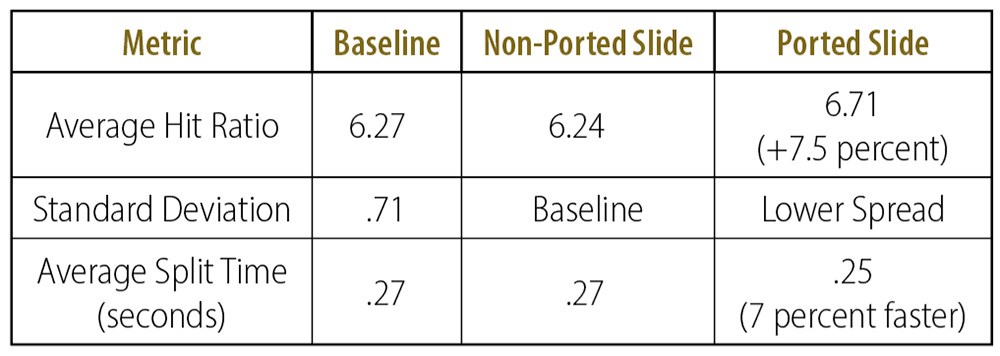
The non-ported slide aligned with the baseline, meaning it neither improved nor worsened consistency, which makes sense. However, the ported slide not only boosted the average hit ratio, but also showed less deviation from the baseline—a critical finding.
This suggests the benefits of porting aren’t just about shaving milliseconds off your split times. They’re about keeping your shots clustered closer to your average, run after run, even when fatigue or stress sets in.
The Math Made Simple: What Standard Deviation Tells Us
If statistics make your eyes glaze over, here’s a straightforward analogy. Average (mean) is like your car’s advertised miles-per-gallon. Standard deviation is the difference between driving that car in perfect weather on a flat highway versus forcing it to go uphill in a snowstorm.
In other words, average shows potential, but standard deviation shows reliability. For shooters, a low standard deviation means your performance is repeatable, while a high standard deviation means your results swing widely, and you might not be able to count on your average when it matters most.
Stress, Variability, and Real-World Defensive Encounters
During a DGU, your body goes into fight-or-flight mode, which induces adrenaline spikes, fine-motor-skill degradation, narrowing of vision and an accelerated heart rate. All of these factors increase variability in shooting performance. A gun or technique that reduces standard deviation under calm conditions will likely help manage stress-induced variability when the stakes are high. This is why the tighter spread I observed with the ported SIG P365 XL is more than a statistical curiosity—it’s a predictor of how the gun will perform when my life depends on it.
Gear vs. Training: Can Your Equipment Choice Lower Your Standard Deviation?
Porting is one gear-based way to tighten consistency. But, it’s not the only factor. Both equipment and training affect your performance variability. Equipment factors include things like ported or compensated slides, as these reduce muzzle rise and promote more consistent shot recovery. Other factors include, but are not limited to: quality sights, which foster faster sight-picture reacquisition and less variation between shots; ammunition choice, which should yield consistent recoil impulse and reduced variability; and grip texture and ergonomics, which means less slipping under stress and a tighter performance cluster.
Training factors include things like high-repetition drills, as the more repetitions you run, the more consistent your muscle memory becomes. Stress inoculation is another, as adding physical exertion, timers or low-light conditions during practice reduces stress-induced variability. Other factors include things like dry-fire practice, which builds consistency in trigger press and sight alignment, or tracking your performance data, as recording hit ratios and split times helps you spot trends in variability.
The bottom line is that gear like a ported slide helps, but only in the context of disciplined training.
Practical Example: Comparing Two Defensive Shooters
Consider two concealed carriers running the same defensive drill: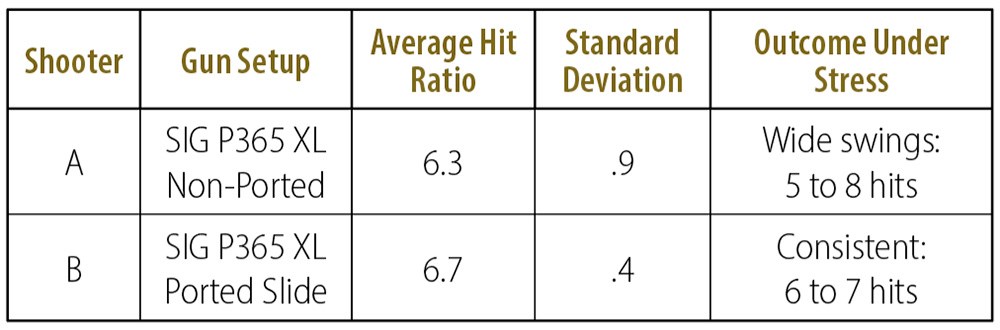
Shooter A might occasionally outperform Shooter B, but Shooter B’s consistency ensures reliability in almost every run. For a defensive encounter—where “good enough” beats “sometimes great, sometimes bad”—Shooter B holds the advantage.
How to Measure Your Own Standard Deviation
You don’t need advanced tools to track this. Here’s a simple method:
Pick a drill
Example: Five rounds at 5 yards on an 8-inch target, run with a timer.
• Run 10 repetitions.
• Record your hit count and split times for each run.
• Calculate your mean.
• Add your hit counts, divide by 10 (the number of repetitions).
• Calculate standard deviation (simplified).
• Subtract your mean from each run’s score.
• Square the results.
• Average those squared results.
• Take the square root of the above to find your standard deviation.
If math isn’t your thing (and believe me, it’s not mine), then do what I do and use a spreadsheet or one of the many free online calculators.
Training to Reduce Variability
Even without changing gear, you can actively work to lower your standard deviation. For example, work with consistency drills, where instead of chasing your maximum speed, train at a controlled pace until your results are repeatable. Alternately, there’s “pyramid training,” where you start slow, build up speed, then return to slow to reinforce control. Another option is to try some fatigue drills, where you might add pushups or sprints before shooting to simulate adrenaline. Lastly, cognitive-load drills will train the brain to perform under stress while maintaining accuracy and safety.
Critical to your progress is to record and review your shooting. Keep a shooting log and monitor not only your averages, but also your spread. The goal isn’t to eliminate all variance (an impossible task), but to tighten your range of variance, so your worst-case performance is still fight-winning.
Tightening the Bell Curve
Most shooters focus only on improving their averages, but in a defensive-gun-use scenario, your worst run may be the one that counts. By lowering your standard deviation, you ensure that even your low-end performance remains effective and reliable.
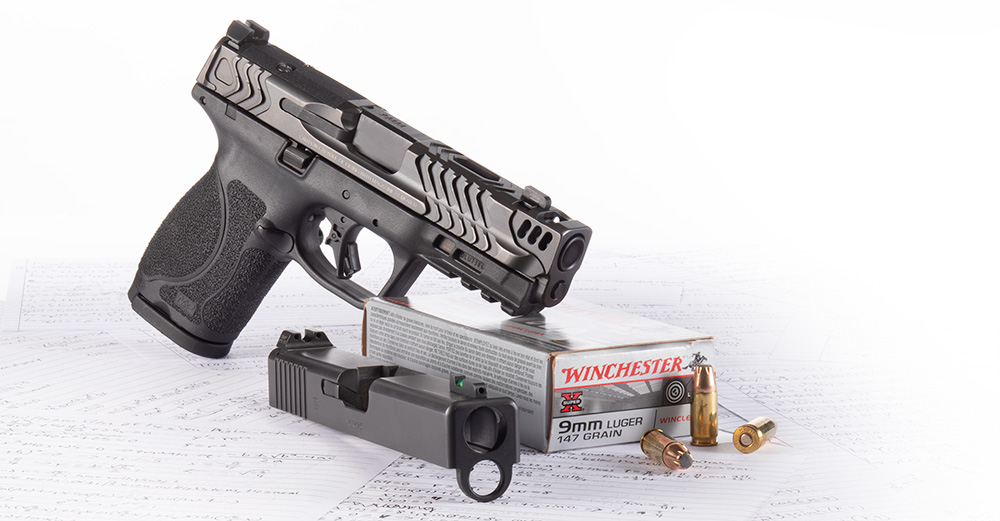
My testing with the SIG Sauer P365 XL with a ported slide showed exactly that: Not only were the averages higher, but consistency was tighter. In other words, porting didn’t just make me a little faster—it made me more predictable. And when your life is on the line, predictability equals survivability.
What Does it all Mean?
Average hit ratios and split times make for great bragging rights, but standard deviation tells the real story of how reliable you’ll be in a defensive-gun use.
From my testing with the P365 XL, the ported slide didn’t just boost averages—it reduced variability, which is arguably the bigger advantage. Combined with focused training that emphasizes consistency under stress, you can ensure your “worst-day” performance is still enough to save your life.
So, the next time you log your shooting drills, don’t stop at calculating averages. Ask yourself: How consistent am I, really? Because when the fight comes, you won’t rise to the level of your best run—you’ll fall to the level of your most repeatable one.