Though the .458 SOCOM is not particularly popular, there are a wide range of factory loads like this hard-hitting one from Buffalo Bore from which to choose.
The idea of a large-caliber, anti-personnel cartridge for an infantry service gun is nothing new. In 1873, the United States Military armed troops with the Trapdoor Springfield rifle chambered for the .45-70 Gov’t cartridge. This concept was abandoned in 1892 when the U.S. Military adopted the .30-caliber Krag-Jørgensen rifle. Ever since, the military has prioritized reach as opposed to big bullets that make big holes—it has been more than a half-century since the U.S. Military began its full-fledged transition to the .223 Rem./5.56 NATO. Still, interest in a heavy, large-caliber projectile has remained.
In his 1998 book, “To Ride, Shoot Straight, and Speak the Truth,” Col. Jeff Cooper described a concept cartridge/service rifle he called “Thumper.” It was a small, lightweight, powerful and controllable infantry carbine that fired the .44 Auto Mag cartridge. This 1971 cartridge was based on a 7.62 NATO case blown out and shortened to accept a 240-grain bullet pushed to 1,800 fps. Thumper never materialized, but it was an inspiration for the .450 Bushmaster, which is an AR-15-compatible cartridge capable of pushing a 250-grain, .452-caliber bullet to around 2,200 fps.
But, before the Bushmaster, there was the .458 SOCOM cartridge created in 2001. The story goes that Marty ter Weeme, founder of Teppo Jutsu LLC, and a member of the U.S. Special Operations world were discussing what they considered the lackluster performance of the 5.56 NATO M855 round during a battle between members of Task Force Ranger and Somali militants. Reportedly, multiple hits with the 5.56 were required to neutralize adversaries. This led to the conception of a large-caliber cartridge compatible with the AR-15/M16/M4 platform in .458-caliber.
Similar wildcat cartridges existed, like the subsonic .458 Whisper, created by J.D. Jones and based on the .458 Win. Mag. case. (Jones also created the .300 Whisper, which was the forerunner of the .300 BLK.) There was also the Barnes .458x1.5-inch, which was created by Frank C. Barnes, the original author of “Cartridges of the World.” It’s re- ported that this cartridge—which could push a 300-grain bullet to about 1,800 fps—was used for silhouette shooting and that it also saw limited action in a subsonic form in Vietnam. The problem was both cartridges utilized belted cases that were not compatible with the M16 family.
Ultimately, the cartridge case used for the .458 SOCOM was the .50 Action Express (AE) pistol case. This cartridge case had a base diameter of .541 inch and a rim diameter of .514 inch. To better interface with the M16’s bolt face, the rim diameter was reduced to .473, which is the same as the rim diameter on a 7.62 NATO. This rebated rim was not a new concept. In 1963, Winchester created the .284 Win., which had a base diameter of .501 inch and the common rim diameter of .473 inch. The feature has since been used on other AR-15/M16-compatible-cartridges like the .50 Beowulf (2001), .450 Bushmaster (2007), the .30 Rem. AR (2008) and the 22 Nosler as late as 2017.
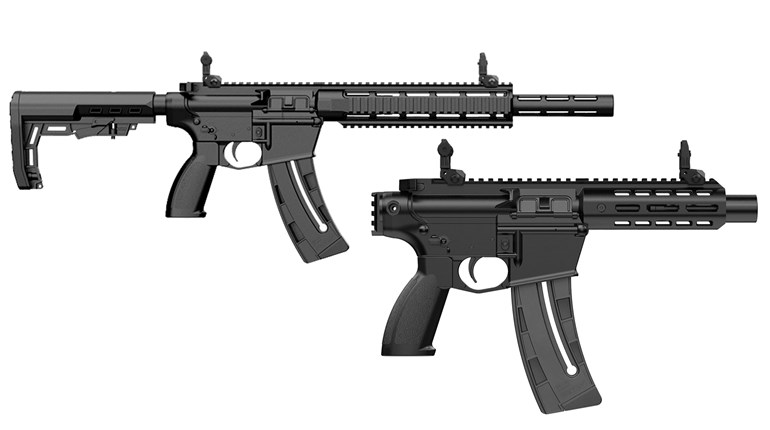
The result was a cartridge with an overall length of 2.26 inches that would work in an AR-15/M16, and the only modifications required were a new barrel, a new bolt and a new follower for the magazine. With the new follower, a 30-round 5.56 NATO magazine could hold 10 rounds of .458 SOCOM, and loaded with a 300-grain bullet at 1,900 fps, it would generate more than 2,400 ft.-lbs. of kinetic energy at the muzzle, which is about the same as a common 7.62 NATO round.
The downside to the SOCOM was its trajectory. With an AR-15 zeroed at 150 yards, its 300-grain projectile will drop 6 inches at 200 yards and almost three feet at 300 yards. However, at 300 yards the .458 SOCOM still has around 30-percent more kinetic energy than a 5.56 NATO M855 bullet. From a practical-application standpoint, an M16 chambered in .458 SOCOM is not an open-battlefield-type gun. However, in urban warfare, where across-the-street and house-to-house combat is common, the .458 SOCOM has a distinct advantage, at least in terms of terminal performance. Large-caliber bullets impacting somewhere between 1,600 and 1,900 fps create serious wounds.
The downside, of course, is how the recoil from this beast negatively impacts rate of fire and accurate follow-up shots. A battle-ready M4 carbine outfitted with an optic will be pushing 8 pounds. Chambered for the 5.56 NATO, the felt recoil is in the 4-pound range. An M4 chambered for the .458 SOCOM will generate five times as much recoil—recoil very similar to a 7.62 NATO.
The .458 SOCOM might indeed eliminate the need for multiple shots required to incapacitate an enemy, but at the same time, it would eliminate the ability to rapidly put multiple shots on target. When you combine that with limited magazine capacity and the important fact that a single .458 SOCOM cartridge will weigh nearly three times as much as a single 5.56 NATO round, it’s hard to see how given the totality of the circumstances it’s a better option, at least as a general-purpose infantry weapon. A Soldier armed with a 5.56 NATO-chambered AR, carrying 10 pounds of ammo, could carry nearly 400 rounds, while a Soldier armed with a .458 SOCOM-chambered carbine could only carry about 140 rounds.
As interesting and as effective as it might be, outside limited applications the .458 SOCOM does not really have a place in military use. This does not mean it is not an interesting and useful cartridge, especially in the civilian world. In some sort of cataclysmic event, it could serve well for personal protection. It would also be ideal as a ranch or home-defense gun in locales where big and dangerous bears live.
Even though the .458 SOCOM is not SAAMI approved, it is popular and has established a cult-like following. From manufacturers like Buffalo Bore, SBR, Wilson Combat and others, there are more factory .458 SOCOM loads to choose from than there are for any of the other AR-15-compatible cartridges with rebated rims, including the .450 Bushmaster. But, it’s not cheap to shoot—expect to pay about $3 every pull of the trigger. Maybe that’s OK. When you feel the push on your shoulder and you see what this cartridge can do, you’ll probably feel like you got your money’s worth.