It's not the first time words tumbled from my mouth before they could be stopped.
"Why in the world does Zeiss call it the Z-Point?" I queried of an innocent passerby at work.
"You're kidding right?" was the immediate response. Apparently not content with the shallow hole I'd dug myself into I delivered my sincerest, "No, why'd they use the letter Z?" The chiding continues to this day, and that question was added to the list of infamous statements I've made over the past five years, including my inquiry as to why I only get voicemails when I'm not in my office.
It's obvious that it was derived from the first letter in the Zeiss name, synonymous with quality optics and innovation. My fruitless search for some sort of explanation also made something else glaringly apparent—many of us try to make things too complicated.
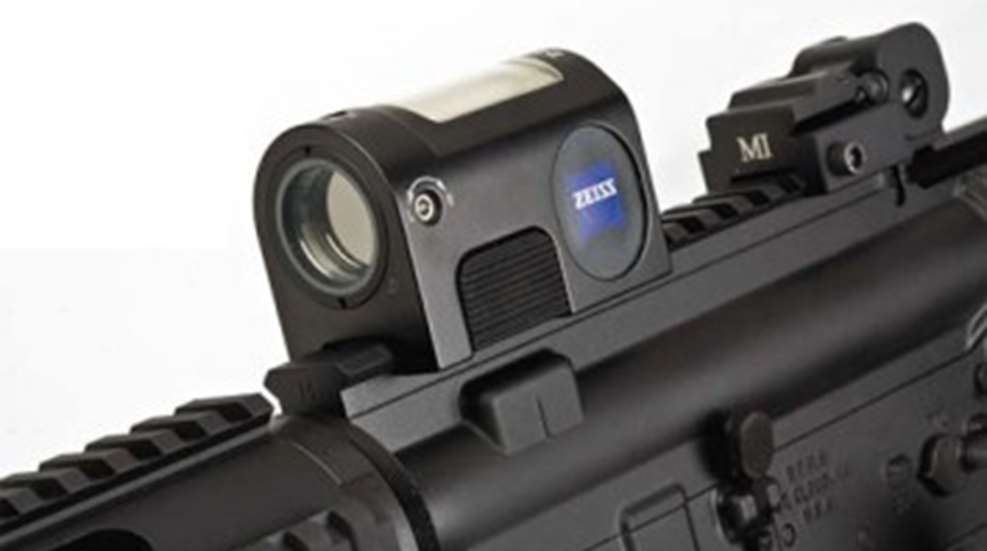
The Z-Point, which was originally designed for the German military, takes the opposite approach. It starts with a lack of squared edges, protruding knobs and wires. There are enough things that can go wrong in a tense situation without your CQB optic getting hung up.
There is no magnification, so both eyes can remain open when engaging a target. That's a big advantage at close range, the precise situation the Z-Point thrives in, especially if you're on the move or multiple assailants are a possibility.
Without the multiple lenses required to magnify a subject, light transmission is also maximized. If you've ever tried to find the crosshair in your variable scope in a dimly lit room, you understand. Plus, this is Zeiss glass, renowned for its ability to transmit light. The unit is also tough and compact. It weighs only 31⁄2 ozs. and measures 2 1/2 x 1 2/3 x 1 1/2 ins. The body is made of high-strength aluminum encased in an impact-resistant polymer housing. With the number we've had in for hunts and testing, I've never seen one crack, fail or even prompt a complaint. It's shockproof, waterproof and vibration-resistant.
The Z-Point can be mounted on Picatinny or Weaver rail, requires no tools and it's easily accomplished in the field. Depress the company's patented spring-loaded clamp on the Z-Point's base, rock onto the rail and release the clamp. Reverse the process to remove or adjust eye relief.
To turn on the unit, momentarily depress the switch, which is flush mounted under the Zeiss logo. A sensor built into the front of the unit then detects ambient light and automatically adjusts the red dot's brightness. Hold the switch down to power off the unit, and if needed, you can also manually adjust the brightness using that same single switch—the only one on the Z-Point. If you're like me, and habitually forget to turn things off, you'll be happy to know the unit powers down after four hours.
The Z-Point also features a dual power system that starts with a CR 2032 battery. It drives the red dot in low-light conditions, but a solar cell takes over in brighter light, prolonging battery life.
Windage and elevation adjustments can be made with an Allen wrench. The field of view at 100 yards is 56.4 ft., and at that range the red dot will cover 3.6 ins. Current MSRP is $568.
Simply put, these units work and work well. Several members of the staff at Shooting Illustrated have used them on turkey hunts, with no problems encountered. But to test the waterproof claims, I put one of the units in the freezer for 72 hours. I then dropped it into 70 degree water and waited another hour. The unit fired up without a glitch, adjusted the dot properly and didn't seem any worse for the wear.
For more information contact Zeiss at (800) 441-3005 or visit www.zeiss.com, just don't ask why they named it the Z-Point. I think we all know that answer.