Imagine the situation where you have encountered a potential threat and the circumstances are such that you are justified in drawing your defensive handgun. So, you do what you have always done in range practice: You draw and aim to the vital zone and, because your sights are on the target, your finger goes to the trigger. The potential for firing an unintended shot may be greater that you realize. You might stumble or a sudden move on the part of the suspect might cause you to perform a trigger press; any number of things might cause the unintended response. And, in the course, of all of this the biggest problem is that you can’t see his hands to know if he is deploying a weapon because your own arms, hands and firearm are in a position that keeps you from seeing his hands and what might be in them.
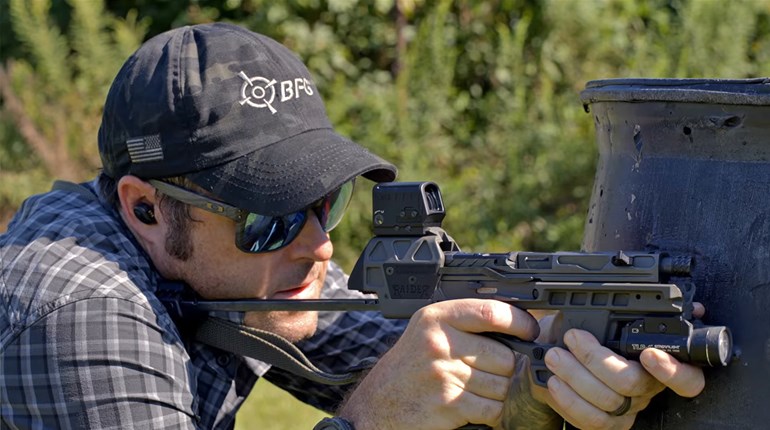
Under such circumstances, the best move might be to draw to the low ready position. In this situation, we are visually focused on the potential threat. We see his hands clearly or we note that they are in his pockets. Either way, we are alert for the possibility that he will deploy a weapon. We make a complete, two-handed pistol presentation with our arms extended, but our trigger finger is straight because our sights are not on target. The gun is pointed low, low enough that we can have an unobstructed view of his hands. Should he produce a weapon, it is a quick a simple move to raise the gun to the vital zone and take care of business simply because we have an unobstructed view of his hands. And, just as important, the potential for an unintended shot has been greatly reduced.
By the way, should his hands be in his pockets, or otherwise out of sight, I am not going to give a command like “Put your hands up!” or “Let me see your hands!” To do so is commanding him to move and now, when he does move, I have to determine if he is going for a weapon or simply following my instructions. I much prefer the command, “Don’t move!” Once he complies, I may give other commands, keeping in mind that my duty as an armed citizen is not to search him, disarm him or even detain him.
Unless faced with an obvious threat, the armed citizen may be well advised to draw to the low ready, instead of going on target. Searching one’s own home or property might be another good example. We need to be able to see clearly, without our own arms, hands, and firearm blocking our view. And we certainly don’t need to be moving about with our finger on the trigger.
Dry practice is a good time to practice drawing to the low ready and then transitioning to the vital zone shot as if the threat has suddenly become real. We should think about what we are actually trying to accomplish and work out the best, safest way to get that done. The low ready position, give that some thought and practice.