My friend and I have a few different handguns we use on a regular basis. Some are for competition, some are for personal defense, some are for casual shooting and I even hunt big game with a handgun. When it comes to maintenance and taking care of our equipment, we have two different schools of thought.
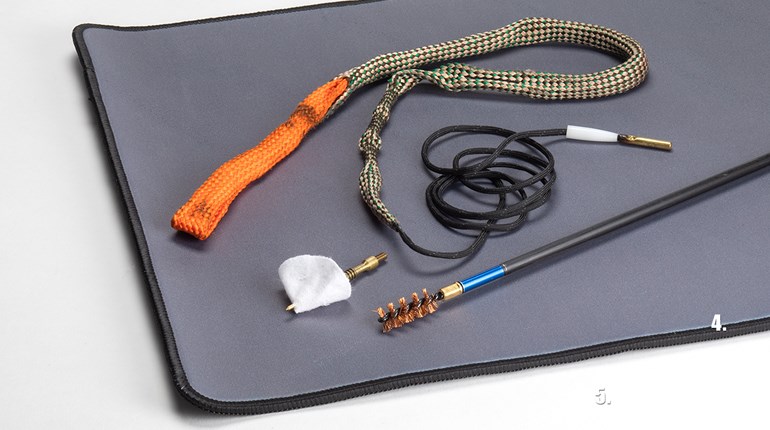
For assorted barrel bores and revolver cylinders, he contends a Boresnake is all that is necessary to condition the bores and cylinders to function and deliver the accuracy we expect from our guns. In fact, other than a cursory exterior wipe down with a silicone cloth and the Boresnake through the barrel, he considers his gun clean. I, on the other hand, tend to be a little more traditional with cleaning, lubrication and general maintenance on my guns. I view the Boresnake as a convenient field expedient to be used as an interim treatment to keep the gun serviceable until I can get to my conventional cleaning gear for a thorough cleaning of the gun before I put it away in the vault. Is my friend’s cursory maintenance regimen sufficient to keep his guns running? Am I being too meticulous in my cleaning habits? Or, is there a happy medium at which we can arrive?
Jarad K., via e-mail
Firearm care and cleaning methods and practices have been, and will continue to be, one of the most widely discussed subjects among gun owners universally. Usually, the application of the firearm dictates the level and detail of maintenance performed on a firearm. In general, any firearm maintenance should preserve all of the components of the gun from deterioration such as corrosion, oxidation and rust. Protecting the exterior finish of the metal and also the wood portions of the gun with a preservative material is also a key factor in gun maintenance. Even the synthetic parts need attention in keeping them free of contaminants such as dirt and firing residue. A simple visual inspection is all that is needed to determine where maintenance procedures need to be applied to the surface finish once firing has been completed or when periodic inspection is performed.
In addition to protecting the gun from environmental factors, firearm maintenance is performed to keep the gun operating properly without an interruption in the cycle of operation. A lack of lubrication and/or a buildup of firing residue and dirt tend to inhibit the mechanical function of the gun. By first removing the carbon and other material built up from the firing process, the friction surfaces are exposed for inspection and lubrication. Any surface that shows wear or a change in appearance due to friction with another surface needs to be lubricated. Lubrication helps to reduce friction, which keeps the gun operating during the firing cycle as well as providing a barrier to firing buildup, making the gun easier to clean when everything is complete. It also has a preservative effect on metallic surfaces helping to prevent oxidation, corrosion and/or rust.
The Boresnake (and similar devices) is recognized as an expedient, intermediate method of maintaining a firearm in between a thorough cleaning, inspection and lubrication, which may be determined by one’s total round count or time intervals. Your friend’s method of cleaning and maintaining his guns is usually considered “good enough” to keep the guns operating—provided he adds some lubrication to the moving parts periodically. Your more detailed method of gun maintenance requires more work and time to complete, but has the advantage of providing a more intimate knowledge of the gun and how it operates.
Guns used for casual shooting or perhaps even competition will probably fare well with your friend’s cleaning methods, as an occasional interruption in the cycle of operation is little more than an inconvenience. Conversely, guns used for personal defense or hunting—especially when hunting game animals that consider you a meal instead of a threat—must be maintained in a condition that I refer to as maximum operational readiness. This means that the gun must work first time, every time without a thought or a concern.
To achieve this state of readiness, the gun must be cleaned, absent of foreign material or firing residue, inspected for missing parts or defects and then lubricated as recommended by the factory. Prior to loading it and putting it into service, it is always good to perform a basic function check to validate that the gun is functioning mechanically as anticipated. These steps will instill confidence in the user should the gun need to quickly be put into operation to perform its intended purpose.
As you can see, the application for which the firearms are to be used plays part in the depth and detail of the maintenance needed to keep it operating satisfactorily. There are indeed times when the Boresnake is sufficient, but sometimes a more thorough maintenance procedure is necessary, depending upon the application for the particular firearm, making you both correct in your views.