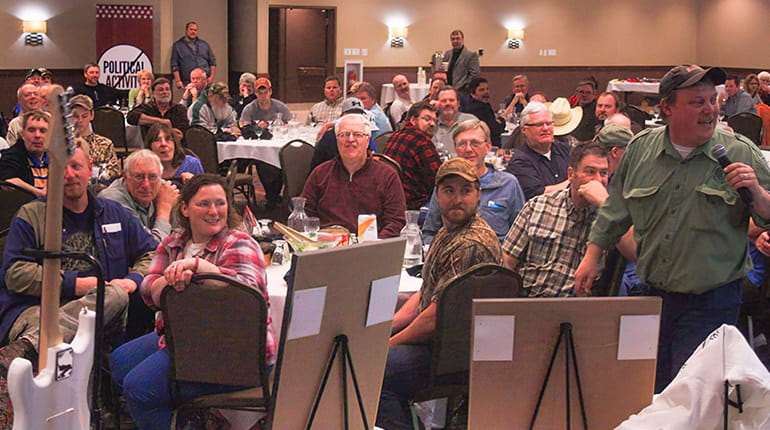
A while back, I covered a few observations gleaned while working with a dozen rifle owners in both classroom and range settings. Having just repeated that process with a similar group, several new takeaways have emerged. The first is that while the class centered around improving each rifle’s accuracy potential, range testing made clear that not everyone has the same ideas about suitable ammunition for such work.
As was the case last time, this group’s age ranged widely, from late 20s to early 80s. They were more experienced than the previous riflemen, both in the shop and on the range. The class involved testing accuracy before and after rifle modifications, but instead of mandating match-grade ammunition, I simply told the students to bring at least one load that they knew to be reliable and fairly accurate in their rifles.
My goal was for each shooter to test their rifle with ammunition they normally use, and hopefully I’d get a chance to show them how barrels don’t always behave the way we think they will. I wasn’t disappointed. Six shooters brought bargain-priced FMJ target loads, two used well-known match loads and one had hunting ammunition. While pre- and post-rifle-modification testing showed respectable 100-yard-group-size reductions across the board, two shooters’ results were still inaccurate by modern standards.
One rifle started the week with a dismal 6.9-MOA average of five-shot, 100-yard groups using a highly regarded, 77-grain match 5.56 NATO load. A popular 70-grain defensive load was even worse. The carbine’s like-new, 1:7-inch-twist barrel came from a pedigreed rifle maker and seemed just right for the task. Shaving slightly more than 1 MOA off the student’s average-group size (through rifle accurization) sounds good by itself, but that still left him with a 5.2-MOA best group at 100 yards.
The rifle’s owner was ready to scrap the barrel, so I encouraged him to try a lighter-weight factory load that I sometimes use for accuracy testing: Hornady’s match-quality, 55-grain V-Max. His initial five-shot group printed less than 1 inch, and for the first time all week, this experienced rifleman was smiling. Another great V-Max group convinced him that the barrel wasn’t a lost cause. He used PMC 55-grain FMJ for the rest of his groups, which averaged a hair larger than 2 MOA at 100 yards.
Prior to this end-of-week range testing, we had subjected his barrel to a battery of inspections and measurements in the shop. Nothing about it gave any indication of poor performance with heavier loads. Still, it bucked the trend for that particular barrel brand and type.
Using a different 55-grain FMJ load, another student saw a 3-MOA reduction in group size after reworking his rifle in the shop. But, the resulting 2-MOA group average still bothered him. I handed him my remaining box of Hornady 55-grain V-Max and his five-shot group average shrunk to 1.2 MOA at 100 yards.
The performance of both the FMJ and V-Max loads was pretty much as I expected in that particular rifle. However, when the student tried a 62-grain factory load that’s normally a ringer for me, it was a flop. This usually tight-shooting ammo grouped worse than his 55-grain FMJ did at the beginning of the week, before any work had been done to the rifle.
These tests provided the group with visible examples of how past performance is only a guide, and that no two barrels are the same. That’s true even when they’re identically configured by the same manufacturer. My lovely wife uses the analogy of kids and allergies to explain this: A child may have a severe, allergic reaction to food that his or her siblings eat without problems. The same is true for barrels from the same “parent” batch.
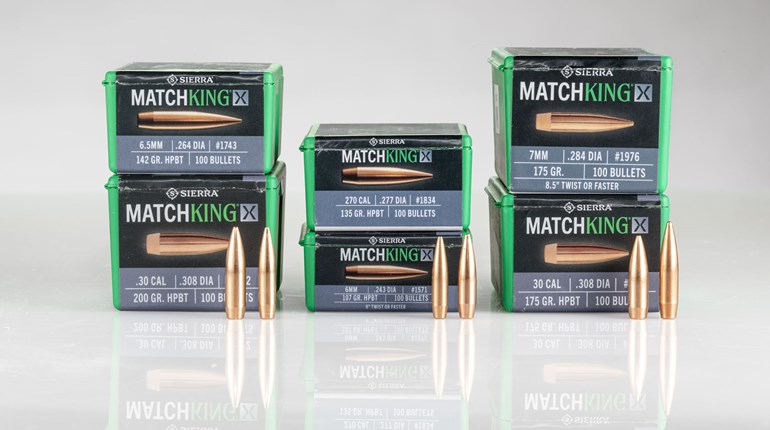
Seldom do we stumble on the best ammunition on the first try. Inexpensive target loads make sense for breaking in barrels, rough zeroing, high-round-count training and other activities that will quickly dent a wallet with more expensive fodder. But, if you’re trying to gauge accuracy, it’s worth sucking up the cost of at least a couple boxes of match-quality target loads to try alongside other ammo types.
Because even no-frills hunting ammunition sometimes equals or outperforms match ammo, I also include one or two good options featuring expanding bullets whenever I’m trying to determine what a barrel likes. Another rifle used during this week of gunsmithing and accuracy testing allowed the class to see this principle in action.
This time it was a .22-250 Rem., made by a budget-priced manufacturer and sporting an inexpensive, 20-inch stainless steel barrel with a 1:14-inch twist. That particular rifle’s owner brought two loads to class: Remington’s 55-grain Pointed Soft Point (PSP) and Hornady’s 55-grain V-Max. After his rifle had been torn down, tuned up and rebuilt properly, Remington’s PSP load was the hands-down winner. This no-frills, conventional soft point averaged .91 MOA to Hornady’s 1.8 MOA across all groups.
That’s not an indictment of the V-Max projectile in a slow-twist, .22-250 Rem. barrel. It’s simply more evidence that you can’t be sure how well or poorly a projectile will perform until you shoot it through a given barrel. For that reason, I do my best to convince owners of new (or new-to-them) firearms to resist buying ammunition in bulk until they’re confident they’ve identified the right stuff to feed their barrels.
Finally, it’s worth remembering that what a barrel likes today is not necessarily going to be its favorite load as the throat and bore begin to show measurable wear. That can be a bitter pill to swallow if you regularly run your rifle hard and suddenly find it no longer shoots your pet ammunition well. But that, and other observations from this week spent in the company of solid riflemen, is a topic for another day.