Varmint and predator hunters demand a lot from a bullet. Not only must the bullet be uniform in weight and construction and inherently accurate in design, it must also withstand velocities upward of 4,000 feet per second—sometimes higher—without stripping through the core or coming apart before reaching its target. Pest shooters want explosive expansion and limited penetration, while most predator hunters need a bullet that delivers a lethal blow with minimal pelt damage. A bullet capable of fulfilling the needs of both seemed improbable—that is, until Barnes introduced the Varmint Grenade last year.
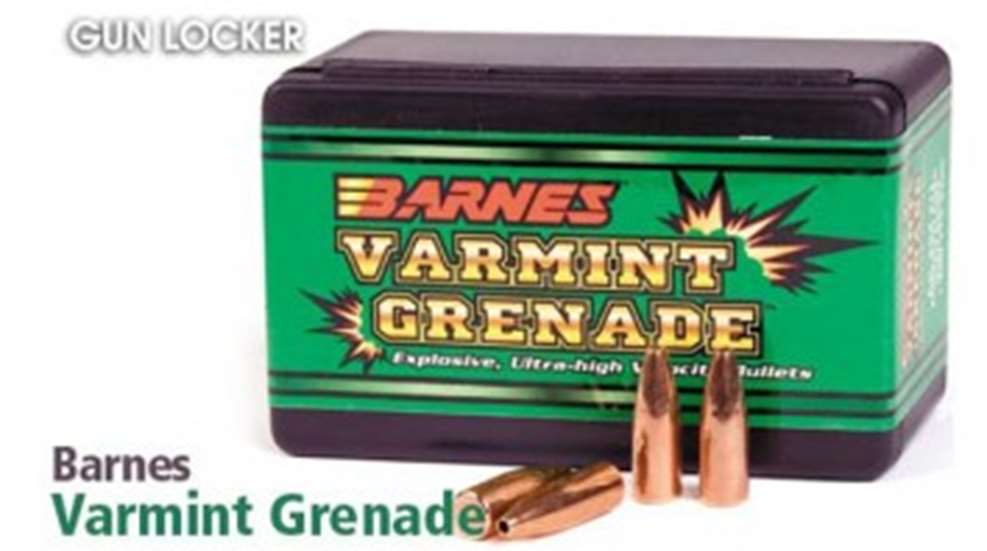
The Varmint Grenade is a 36-grain, .224-inch lead-free bullet with a highly frangible, compressed core consisting of a copper and tin composite. The core material is less dense than lead, making the bullet longer than if the latter were used. It approaches the overall length and ballistic coefficient of heavier lead-core bullets, and greatly exceeds those specifications of bullets in the same weight class. A volatile core, combined with a scored, thin jacket, wide meplat and cavernous cavity make the bullet extremely fragile.
According to Barnes, the Varmint Grenade "vaporizes" ground squirrels and prairie dogs while leaving little or no exit wound on larger animals, such foxes and coyotes. This sounded too good to be true, so I put the new bullet through a host of tests, the first of which was to see its expansion characteristics.
Shooting a Bullet Test Tube at 10 yards, I discovered the Varmint Grenade began expanding approximately 1⁄4 inch after impact. On animals with relatively thin hides, such as predators, this equates to well inside the chest cavity. Within the first 2 inches of penetration the wound cavity reached maximum diameter, and at 5 inches it closely approximated the diameter of the bullet before upset. A small piece of the base and sidewall penetrated 8 inches.
To examine on-game performance, I shot several bullets into nuisance beaver carcasses. Regardless of distance or shot angle, the results of the Bullet Test Tube were mimicked—a bullet-diameter entrance hole and no exit. The verdict: When shooting a fox- or coyote-size animal, expect a small entrance hole and little, if any, exit wound. On small varmints the damage should be catastrophic. Barnes' claims held true.
The most accurate gun I had on-hand, a Savage Model 12 Long Range Precision Varminter in .22-250 Remington, was used to determine the bullet's accuracy potential. Hodgdon H380 powder, Federal Gold Medal 210M primers and Remington cases completed the load, and the bullet was seated to give an overall length of 2.350 inches. Working in .1-grain increments of H380 from 38.0 to 41.0 grains, the best accuracy came with 39.5 grains, producing an average velocity of 3,915 feet per second and turning in a five, three-shot-group average of .325 inch at 100 yards.
For those who do not handload, the Varmint Grenade bullet is also available in .223 Remington by Black Hills Ammunition. This load has a muzzle velocity of 3,750 feet per second.