BS_011

Buckshot Basics

How much do you know about buckshot?

By Richard Mann (RSS)
January 31, 2012

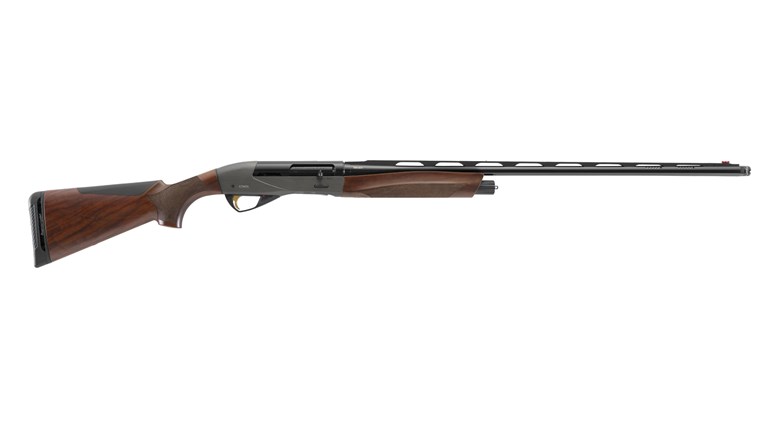
Buckshot is the primary load carried by law enforcement in shotguns and what you’ll find stuffed in many scatterguns kept for home defense. Yet, a lot of shooters don’t understand exactly what buckshot is or the differences between the various buckshot loads available.

Back in the day, when pistols fired lead round balls and most rifles fired pistol cartridges, a shotgun loaded with buckshot was immensely more devastating because it could drive eight or 10 similar-size lead balls into a villain with one shot. A century ago, looking down the barrel of a shotgun was about as fearsome a thing as you could face. Buckshot was bad medicine.

Advertisement

As bullet development progressed, defensive handgun cartridges became more lethal because the bullets not only expanded, they often fragmented. This created devilishly destructive wound cavities—not just holes like the lead bullets of the past. But, the shotgun has remained popular as a defensive option. The fame it gained on stagecoaches is where the term “riding shotgun” originated.

Buckshot-loaded shotguns are short-range firearms. Many still believe they are the most feared guns and put a lot of stock in what I consider an urban legend. This improbable proverb suggests if you pump the action of a Remington Model 870, bad guys will melt with fear. Some consider this a certainty. When my police department switched to Beretta shotguns, the chief believed it a bad idea because his officers could not make that “racking” sound anymore. Bad guys do not go to a bad-sounds-that-make-you-run school. If you need to go to a gun, you better be prepared to use it. Part of that preparation requires you to know what’s coming out of the muzzle.

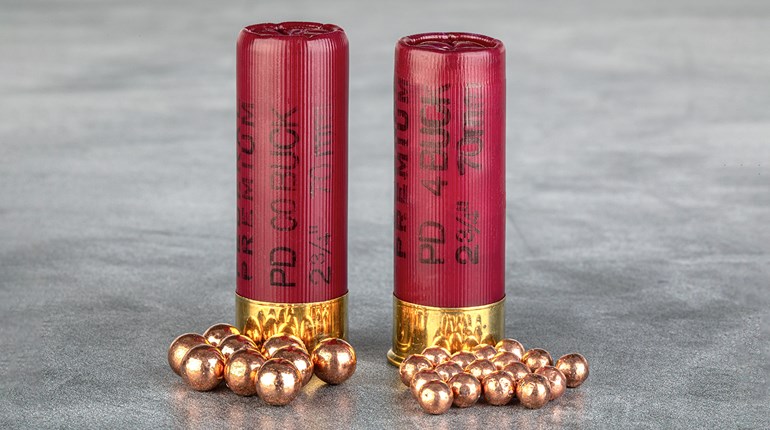
Buckshot comes in various sizes. Nominal pellet diameter ranges from .24 caliber for No. 4 buck to .38 caliber for four-ought buck. The most popular buckshot is 00 buck, which has a nominal pellet diameter of .33 caliber. The number of pellets per shell is governed by their size and their weight. Generally, shotshell ammunition has a payload of between 3⁄4 and 1 1⁄2 ounces. It takes about eight 00-buck pellets to make up a 3⁄4-ounce load. The more the payload weighs, the more recoil you’ll experience. Recoil can also be increase with velocity. Most buckshot loads vary in velocity between 1,100 and 1,600 fps.

Recoil has to be considered for a defensive gun. Remington’s Magnum 00-buck load has 12 pellets—about 1 1⁄8 ounces of shot—launched at almost 1,300 fps. This load is not pleasant to shoot. It’s capable of dislodging fillings, changing your mind and blurring vision during the process, making practice as pleasant as visiting your mother-in-law and fast follow-up shots as difficult as a return visit. On the other hand, Remington offers an eight-pellet Managed-Recoil, 00-buck load at 1,200 fps with recoil half that of the Magnum load.

As for terminal performance, the more shot you have in a shell, the more holes you make in the bad guy. However, to get more shot inside a shell, the shot needs to be smaller. No. 4 buck will penetrate about half as deep—7 to 9 inches—as 00 buck. But a 3⁄4-ounce load of No. 4 buck is filled with 21 pellets, where a 3⁄4-ounce 00-buck load contains only eight pellets.

Since there’s no perfect answer when it comes to terminal performance, you need to consider that the deep-penetrating 00-buck load is capable of shooting through walls in your home and retaining enough energy to cause a lethal wound. Therefore, it might not be the best choice for home defense. Some suggest, and I agree, that more common game loads or smaller buckshot can be better in a home-defense situations. Granted, smaller shot limits penetration, but inside 30 feet—a reasonable in-home engagement distance—any shotshell load is nasty, but when used at contact distance they’re almost immoral.

Aside from shot size, recoil and shot quantity, understanding the range limitations of buckshot is critical to employing it effectively. With the help of a big guy with a thick shoulder, I conducted a test using six, 12-gauge buckshot loads to see how patterns spread from 5 to 25 yards. Using a cylinder-bore shotgun, we discovered when shooting beyond 20 yards at least one pellet will likely miss a human-size target. Beyond 30 yards, you’ll struggle to keep half the pellets on a silhouette. As a conservative rule of thumb, you can expect buckshot patterns to spread 1 inch per yard. In other words, a buckshot pattern at 15 yards should be about 15 inches.

As with everything in life, there was an exception. Federal’s Personal Defense, Copper-Plated, nine-pellet 00-buck load with the FlightControl Wad consistently delivered tight patterns half as large as the other loads tested. Is this a good thing? It could be if your aim is true; a tight cluster of pellets in the vitals will likely be a fight-stopper. However, it could also result in missing altogether.

To me, the standout tested load was the Remington Managed-Recoil, 8-pellet 00-buck load. It was unbelievably pleasant to shoot and patterns were just slightly smaller than standard buckshot loads.

In an effort to shrink patterns, a full choke was tried, but didn’t fare well. Patterns were the same or larger than those with the cylinder-bore choke. Wide flyers were a given with all loads.

Ideally, test several buckshot loads in your shotgun to find one that delivers the pattern and number of holes in the target you feel is best for your needs. Buckshot can be a viable self-defense tool, but to paraphrase Harry Callahan—Clint Eastwood’s character in the 1973 film “Magnum Force”—a man’s got to know [his buckshot and] his limitations.
Tags: , , ,


Comments

11 Responses to Buckshot Basics

  1. randy says:

    Your chief was a very smart man. I’ve seen first hand how the racking of a pump shotgun will change a bad guys attitude. It’s all in the mind, control the mind and the body follows.

  2. Karl says:

    I’ve done a lot of buckshot patterning with my guns to see what I like. At 20 yards from the same gun, Remington 00 is about 12′ and Federal Flitecontrol is about 6′, both very consistently. I think a lot of the missed pellet and ‘over penetration’ [(]whatever that is[)] talk is out of context. If I am not in a legally defensible, in fear of my life situation, I had better not be shooting in the first place. If I am, I need to hit first and hard. Background, bystanders, family, etc all figure in no matter what I might be shooting. At the end of the day, if a shotgun is not giving me an increased margin of error for hitting within my self-defense range, why am I using it? Inside 20 yards I see no practical difference between Flitecontrol and slugs.

  3. Charles Tibbals says:

    I’m not sure why ‘comfort’ should even be a consideration when shooting at a bad guy.

  4. Pingback: Buchshot range | Kimshin

  5. Pingback: Buck to Slug | Shooting Illustrated

  6. Hekkenschutze says:

    I used a shotgun for home defense. Nothing more than 15 feet anywhere inside my home. If any of my shot strays … well then my second reason for a shotgun comes into play: buckshot is loathe to penetrate sheetrock, drywall and the like which could endanger my family (whom I’m wanting to protect) and my neighbors. My wife has a loaded handgun in the bedroom and knows how to get the kids to cover with a handgun if I am down, and knows to call the cops if she hears me shooting. So with my family safe, house cleared and bad guys outside I can enter my Man Cave where I can pick and choose where to go from there.

  7. I HAVE SHOT OVER 1000 12 GUAGE SHOTGUNS AND AT LEAST 100 00 BUCK,AND I DONT EVEN REMEMBER SHOOTING 1 TIME,YES IT HAS A GREAT KICK BUT WHEN YOUR HUNTING,OR TOSSING CANS YOU DONT FEEL A THING,IF YOU DO,YOU HAVE NO REASON FIRING A WEAPON

  8. janice says:

    Someone hit our metal home with buckshot three days ago (made quite a racket). Counted 20-25 holes or indentions in a spray pattern of about eight to 10 inches in depth, 10-11 feet wide, about 10-12 feet off ground. Approx. 80′-100′ from road, lot of trees between house and road.
    Would like to determine about how far away shooter was, type shot, etc. — any input. Thanks.

  9. Greg says:

    Over the years I’ve read articles advocating just about every type of weapon in every type of caliber as a home defense weapon. Richard’s well written article stands out as one of the best I’ve ever read. Whether you agree with him or not his approach is insightful and a catalyst for intelligent debate.

    I grew up in the 50s. My dad and many of his friends had pump action shotguns. I would imagine that most folks growing up in that era were familiar with the distinct racking sound of a pump. I’m not so sure if the young urban thugs of this generation even know what this is or what it implies.

    From a practical perspective the long gun vs. handgun debate depends greatly on how your home is arranged. The edge goes to a shot gun in an open floor plan in my opinion. In the case of a home with many twists and turns a shorter gun in more efficacious. In particular, areas of the home that would require an approach using your off-hand (left if your a righty). Whether you have a hand gun or a long gun the off-hand approach is a challenge for even the most experienced shooters.

    An old timer that I knew was an advocate of the sawed-off shotgun with OO buck as a home defense weapon. The sawed-off has many of the advantages of both a hand and long gun. An argument can be made that it has an advantage over both the hand and long gun in off-hand situations. Of course the sawed-off is illegal. I think that this legislation was from a era where automatic pistols were not common or hard to get.
    Thugs don’t care about the law anyways. If the sawed-off was superior for what they want to use it for they would be using them. They are not. Alas in todays political environment legalizing the sawed-off for home defense would not get very far. Having an illegal one would put you on the FBI radar (Ruby Ridge).

    I would think that if you chose a shotgun for home defense one must consider “Buck Fever”. Even an experienced outdoorsman may get jittery when in a real life or death situation. I have a lot of experience with a Remington Model 1100, occasionally I have initial chambering issues. I would not want to have a shell in the chamber because of my kids. I would think that a pump would be better in these regards but I have very limited experience with one. Anybody have any thoughts on that issue.

    Another question I have is on wall penetration. I imagine that there are many variables to consider. I’m sure that #6 shot could go through a wall at point blank. In a home with a large family any firearm discharge could have untoward results. But it also seems to me that a shot gun with the right shot would minimize those concerns.

  10. kyle says:

    12g shotgun do recoil alot for average people me being 6’6 274 pds doesn’t bother me i have a custom mossberg 88 chamber size 3.5 30 inch barrel i have a mod choke it’s very accurate 110 ft about a 10 to 12 inch spread on birdshots 6′s by remington 8′s by winchester magnum express buckshot by remington about 5 to 6 inches at 110 to 115 ft winchester 3inch buckshots about 8inches not bad but my 500 cruiser 20 inch barrel at 30ft remington magnum express buckshot about 6 inch spread my pops over and under has no choke 26 inch barrel spreads about 16inches at 110 ft stopping power of a 12g don’t take it for a joke it’ll be devasting wounds of a 12g shotgun are horrifying don’t say a shotgun has limited abilities slugs shoot further for the range you people complain about penetration 12g penetrates alot

Leave a Comment

Your email address will not be published. Required fields are marked *

*

*


You may use these HTML tags and attributes: <a href="" title=""> <abbr title=""> <acronym title=""> <b> <blockquote cite=""> <cite> <code> <del datetime=""> <em> <i> <q cite=""> <strike> <strong>